Soften first,
then strengthen.
Last month we laid the foundation: five pillars, one direction. This month we step inside the first of them.
I had planned to open with cold. The longer I sat with the five pillars, the clearer it became that heat belongs first. Cold asks the body to brace. Heat invites it to soften, and to do its quiet work of repair. Forty years of practice have taught me to trust that order: soften first, then strengthen.
So we begin with heat.
Heat comes first because it is the oldest tool we have. Before there were laboratories, there were hearths, hot stones, steam, and small dark rooms where people went to sweat out a winter, a grief, a heaviness of spirit. Nearly every culture that lived through cold found its way to a heated room. That is not coincidence. That is memory.
Heat also comes first because its science is the most mature of our five pillars. The Finnish research in these pages followed thousands of people in their middle years for two decades. It is observational, and I will show you where its edges are. But it points in one direction, and it has for a long time.
Inside: what heat asks of your cells, the honest difference between infrared and traditional saunas, a ritual you can begin this week, and the one sauna I would bring into a home.
Cold arrives in the next issue, and it will mean more once you have learned to sit with heat.
The body holds the work. These are the tools that hold the body.
In the mid-1980s, researchers in Kuopio, Finland, began following a population-based sample of middle-aged men for the Kuopio Ischaemic Heart Disease Risk Factor Study, known as KIHD. They recorded blood pressure, cholesterol, smoking and fitness, and one question few researchers outside Finland would have thought to ask: how often do you take a sauna?
In 2015, Tanjaniina Laukkanen and colleagues published the answer in JAMA Internal Medicine. After adjustment for conventional cardiovascular risk factors, men who used the sauna four to seven times a week had the lower risk of sudden cardiac death shown above, compared with men who went once a week. Similar inverse associations held for fatal coronary heart disease, fatal cardiovascular disease and death from all causes.
Duration mattered too. Sessions longer than 19 minutes carried about half the risk of sudden cardiac death of sessions under 11 minutes.
The sauna in question was the traditional Finnish kind: hot, dry air around 80°C, with water ladled over stones.
Two years later, the same cohort produced a second result. Men who used the sauna four to seven times a week were 66% less likely to receive a dementia diagnosis over the same two decades than once-a-week bathers (Age and Ageing, 2017).
This is the question I hear most. At first, women were not included. In 2018 the team published a KIHD analysis in BMC Medicine of 1,688 adults, mean age 63, more than half of them women. The pattern held for both sexes after adjustment for physical activity, socioeconomic status and established risk factors. Adding sauna habits to a standard risk score also sharpened its prediction of who would die of heart disease.
Observational data cannot prove cause. Finns who sauna daily may differ in ways no questionnaire captures, and researchers can adjust only for what they measure. What makes these findings credible is their consistency, their dose-response pattern, and the mechanistic studies that followed. Those are overleaf.
Pillar I · Heat· Laukkanen T, Khan H, Zaccardi F, Laukkanen JA. Association between sauna bathing and fatal cardiovascular and all-cause mortality events. JAMA Intern Med. 2015;175(4):542–548. doi:10.1001/jamainternmed.2014.8187
· Laukkanen T, Kunutsor S, Kauhanen J, Laukkanen JA. Sauna bathing is inversely associated with dementia and Alzheimer's disease in middle-aged Finnish men. Age Ageing. 2017;46(2):245–249. doi:10.1093/ageing/afw212
· Laukkanen T, Kunutsor SK, Khan H, et al. Sauna bathing is associated with reduced cardiovascular mortality and improves risk prediction in men and women. BMC Med. 2018;16(1):219. doi:10.1186/s12916-018-1198-0
Every cell in your body carries an ancient set of instructions for heat. When core temperature rises, the cell produces more of a family of molecules called heat shock proteins. Their work is housekeeping at the molecular level: they help other proteins hold their correct shape, refold the ones heat has disturbed, and escort damaged ones toward clearance.
Kevin Kregel's review in the Journal of Applied Physiology (2002) describes these proteins as essential to cellular survival under stress, and as part of how tissues build tolerance to the next stress. This is hormesis in its plainest form: a brief, controlled challenge that leaves the system more resilient than before.
The human data is younger, but it exists. In a randomized trial at the University of Iowa (Iguchi et al., 2012), 25 healthy adults, men and women, sat in a 73°C chamber for 30 minutes. Core temperature rose by 0.8°C, heart rate climbed to about 131 beats per minute, and circulating HSP72 rose by roughly 49%. Norepinephrine rose 58%.
The authors' conclusion was measured: whole-body heat triggers some of the same responses as exercise. For a woman in her second chapter, that matters. Heat is not a replacement for movement. It may be a companion to it, especially in the seasons when movement is harder.
Eight weeks of hot-water immersion, four to five times a week, nearly doubled flow-mediated dilation (5.6% to 10.9%), a marker of how well blood vessels relax, in sedentary adults. Arterial stiffness and blood pressure also improved compared with a sham group.
Brunt et al., J Physiol 2016In a small randomized, sham-controlled trial, a single session of whole-body heat was associated with lower depression-scale scores for six weeks. Early and promising research, not a substitute for care.
Janssen et al., JAMA Psychiatry 2016A review of the sauna evidence proposes improved endothelial function, reduced arterial stiffness, a rebalanced autonomic nervous system and lower blood pressure as the likely pathways behind the Finnish associations.
Laukkanen, Laukkanen & Kunutsor, Mayo Clin Proc 2018A systematic review found 40 clinical studies of regular dry sauna use, with 3,855 participants. Most reported benefits, but only 13 were randomized and most were small. Better trials are still needed.
Hussain & Cohen, Evid Based Complement Alternat Med 2018Your body already knows how to do this. The heat simply reminds it.

· Kregel KC. Heat shock proteins: modifying factors in physiological stress responses and acquired thermotolerance. J Appl Physiol. 2002;92(5):2177–2186. doi:10.1152/japplphysiol.01267.2001
· Iguchi M, Littmann AE, Chang SH, et al. Heat stress and cardiovascular, hormonal, and heat shock proteins in humans. J Athl Train. 2012;47(2):184–190. doi:10.4085/1062-6050-47.2.184
· Brunt VE, Howard MJ, Francisco MA, et al. Passive heat therapy improves endothelial function, arterial stiffness and blood pressure in sedentary humans. J Physiol. 2016;594(18):5329–5342. doi:10.1113/JP272453
· Janssen CW, Lowry CA, Mehl MR, et al. Whole-body hyperthermia for the treatment of major depressive disorder: a randomized clinical trial. JAMA Psychiatry. 2016;73(8):789–795. doi:10.1001/jamapsychiatry.2016.1031
· Laukkanen JA, Laukkanen T, Kunutsor SK. Cardiovascular and other health benefits of sauna bathing: a review of the evidence. Mayo Clin Proc. 2018;93(8):1111–1121. doi:10.1016/j.mayocp.2018.04.008
· Hussain J, Cohen M. Clinical effects of regular dry sauna bathing: a systematic review. Evid Based Complement Alternat Med. 2018;2018:1857413. doi:10.1155/2018/1857413
Rhonda Patrick trained as a laboratory scientist before she became a public one, first in cell metabolism and cancer, then in micronutrients and aging. Through FoundMyFitness, the platform she founded, she translates primary research for people who will never read a methods section.
In 2021 she and co-author Teresa Johnson published Sauna use as a lifestyle practice to extend healthspan in Experimental Gerontology. It frames the sauna as hormesis: brief, passive exposure to roughly 45–100°C that produces mild hyperthermia and a coordinated neuroendocrine, cardiovascular and cytoprotective response. Repeated sessions acclimate the body to the next exposure.
She has since co-authored two small UCSF-led studies pairing whole-body heat with cognitive behavioral therapy for depression (2024, 2025). Early work, labeled as such.
Growth hormone. She cites a 1986 Finnish study in which men sitting at 80°C for an hour, twice a day, showed a 16-fold rise by day three. It faded later in the week, and a 1987 study found no response in men aged 49 to 66. Real, brief and age-dependent.
Blood pressure. Among 1,621 Kuopio men followed for nearly 25 years, those bathing four to seven times a week were about half as likely to develop hypertension: one plausible route to the heart findings.
The lungs. Among 2,210 men, frequent bathers had fewer hospital cases of pneumonia over 25 years. The link weakened after full adjustment: a lead, not a conclusion.
Four to seven sessions a week compared with one. An association, not proof, and it held for women and men alike, at every age studied.
She treats the sauna as a dose, with a frequency, a temperature and a duration, rather than as a luxury. That is how The Trove asks you to read every pillar: measured, repeatable, and yours.
Plain links. None are affiliate links.
· Patrick RP, Johnson TL. Sauna use as a lifestyle practice to extend healthspan. Exp Gerontol. 2021;154:111509. doi:10.1016/j.exger.2021.111509
· Mason AE, et al., incl. Patrick RP. Whole-body hyperthermia with CBT for depression. Int J Hyperthermia. 2024;41(1):2351459. doi:10.1080/02656736.2024.2351459 · Glob Adv Integr Med Health. 2025;14. doi:10.1177/27536130251387714
· Leppäluoto J, Huttunen P, Hirvonen J, et al. Endocrine effects of repeated sauna bathing. Acta Physiol Scand. 1986;128(3):467–470. doi:10.1111/j.1748-1716.1986.tb08000.x
· Zaccardi F, et al. Am J Hypertens. 2017;30(11):1120. doi:10.1093/ajh/hpx102 · Kunutsor SK, et al. Respir Med. 2017;132:161. doi:10.1016/j.rmed.2017.10.018 · Kunutsor SK, et al. Neurology. 2018;90(22):e1937. doi:10.1212/WNL.0000000000005606
· Leppäluoto J, Tapanainen P, Knip M. Heat exposure elevates plasma immunoreactive growth hormone-releasing hormone levels in man. J Clin Endocrinol Metab. 1987;65(5):1035–1038. doi:10.1210/jcem-65-5-1035
| Traditional | Infrared | |
|---|---|---|
| How it heats | A stove heats stones and air; the air heats you. Water on the stones (the Finns call the steam löyly) raises the felt heat. | Emitters warm the body more directly while the air stays comparatively cool. |
| Air temperature | Roughly 70–100°C (158–212°F). | Roughly 45–65°C (113–150°F). |
| A typical session | 10–20 minutes, often in rounds with cooling in between. | 20–40 minutes in one longer, gentler round. |
| How it feels | Intense, enveloping, ceremonial, often social. | Gradual and quiet. Easier to breathe for women who find high heat overwhelming. |
| The evidence | The modality studied in the Finnish cohorts. Decades of population data. | Smaller clinical studies. A 2009 review in Canadian Family Physician judged the evidence promising but limited (Beever). |
| In your home | Usually a dedicated 240V circuit and an electrician. Longer warm-up. Indoor or garden builds. | Many indoor cabins run on standard household power (check the model). Shorter warm-up. |
| Best for | The purist who wants to mirror the research conditions and loves the ritual. | The woman who wants a daily-possible practice inside the home, with gentler heat. |
If you want to stand closest to the evidence, choose traditional: it is what the Finns studied. If you want the sauna you will step into four times a week, for many women that is infrared. So the deciding question is not which heat is better, but which you will still be using in February: the one that fits your home, your nervous system and your week. The Trove Pick, overleaf, is infrared, and here is why. If you lean traditional, my buying guide is online: Choosing a Home Sauna.
· Beever R. Far-infrared saunas for treatment of cardiovascular risk factors: summary of published evidence. Can Fam Physician. 2009;55(7):691–696. PMID 19602651
A ritual differs from a routine in one way: attention. The Finnish men in the research were not chasing a number. They were keeping a habit that their parents and grandparents kept, week after week, for decades. Begin there. The protocol below is a starting frame for healthy adults, not a prescription. Your body will tell you how to adjust it, if you let it.
Weeks one and two: two sessions. Weeks three and four: three. From there, build toward four or more if your body welcomes it. That is where the Finnish associations were strongest. Consistency over intensity, always.
Traditional: begin with 8–10 minutes and build to 15–20. Infrared: begin with 15–20 minutes and build to 30–40. Leave the moment you feel light-headed, nauseous or unwell.
A glass of water before you enter and another after. Sweat carries sodium as well as water, so after long or frequent sessions, replace it with an electrolyte drink or a pinch of mineral salt in water. No alcohol before or during: in the heat it raises the risk of low blood pressure and arrhythmia (Hannuksela & Ellahham, 2001).
Stand slowly. Sit for several minutes. A lukewarm or cool rinse is enough; the ice can wait for next month. Let your heart rate settle and your breath lengthen before you return to the day.
Missed a week? Restart one stage back rather than where you left off.
On hot flushes: if you are in perimenopause, heat may feel like the last thing you want. Many women find a gentler infrared temperature and an evening session easier. Listen, and adjust.
· Hannuksela ML, Ellahham S. Benefits and risks of sauna bathing. Am J Med. 2001;110(2):118–126. doi:10.1016/s0002-9343(00)00671-9
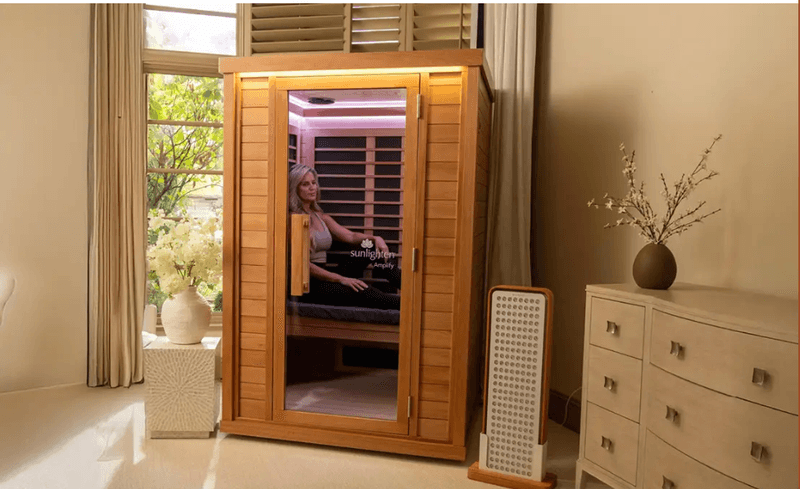
Sunlighten has built infrared saunas since 1999, and its cabins carry the details I look for in anything that lives in a home: low-EMF design and sustainably sourced wood (per the manufacturer), and full-spectrum near, mid and far infrared on the mPulse line. The gentler air and the short warm-up make a session realistic on an ordinary weeknight, not only on a free Sunday.
The woman ready to make heat a weekly practice rather than an occasional spa visit. She has an indoor corner about the size of a wardrobe, prefers gentler heat, and values design as much as function.
Cost per use. Take an illustrative $8,000 cabin, used four times a week for ten years: 2,080 sessions, about $3.85 each. Check current pricing for your model. The investment is only as good as the habit, so buy it when you are ready to use it.
Before you commit, confirm the footprint, electrical requirements, delivery time and warranty for your model, and ask for the EMF test report rather than the marketing line. Decide where the towel and water will live, too: the less setup a session needs, the more often it happens.
· Imamura M et al. J Am Coll Cardiol. 2001;38(4):1083–1088. A Japanese far-infrared protocol: 60°C for 15 minutes, then 30 minutes resting under blankets, daily for two weeks. In 25 men with coronary risk factors, flow-mediated dilation, a measure of how well blood vessels relax, rose from 4.0% to 5.8%.
· Small and short, in men only: a reason for interest, not a promise. The Finnish and infrared reviews are on pages 3, 4 and 6.
Affiliate disclosure: The Trove earns a commission on qualifying purchases. Researched, not personally tested: we feature only products in categories with credible published research behind them.

Spirit · the fifth pillar,
present in the first
On three continents, the heated room was built not for luxury but for return. I offer these traditions with respect, as a student of them rather than a keeper.
TemazcalIn Mesoamerica, the temazcal, from the Nahuatl temazcalli, often translated as "house of steam," is a low domed room of stone or adobe. Heated volcanic stones and medicinal herbs fill it with fragrant steam. Traditionally guided by a temazcalera or temazcalero, it has long been used for purification, for prayer, and for women after childbirth. It remains a living practice across Mexico and Central America.
The sweat lodgeMany Indigenous Nations of North America hold sweat lodge ceremonies, among them the Lakota inipi. These are sacred ceremonies, held within specific traditions and led by those entrusted to lead them. They are not a wellness format, and their details are not mine to share. The respectful posture is simple: if you are invited, go as a guest, follow the guidance of the keepers, and never pay a stranger to imitate one.
The banyaIn Russia and across much of Eastern Europe, the banya is a social and almost devotional institution: moist heat, bundles of birch or oak leaves called venik used to move heat across the skin, cold water, tea and long conversation. Generations have treated it as a place to restore body and spirit together.
What these traditions share is not a temperature. It is intention, community, and the understanding that body and spirit are cleansed in the same room.
The practice · this weekBefore your next session, pause at the door. Name one thing you are ready to set down. Inside, breathe slowly and let the heat work without your supervision. When you step out, drink your water as if it were a blessing. The science calls this hormesis. Your grandmothers had other words for it.
Each month, this page tracks what the Department of Health and Human Services under Secretary Robert F. Kennedy Jr. has changed, proposed or put up for review. I keep it factual and nonpartisan, mark what is final and what is not, and include the critics alongside the champions. The backdrop: the MAHA Commission's assessment (May 2025) tied rising chronic disease to ultra-processed food, chemical exposures and overmedication, and was corrected after reporters found citations to studies that did not exist. Its strategy (September 2025) set out more than 120 initiatives. Here is what has moved since.
The Dietary Guidelines for Americans, 2025–2030 replaced MyPlate with an inverted pyramid. Protein, dairy, healthy fats, vegetables and fruit now sit at the wide top, and whole grains at the narrow base. The guidance: prioritize protein at every meal, choose full-fat dairy without added sugar, get fats from whole foods, drink less alcohol, and limit highly processed foods and added sugars.
Why it matters at 38–58: protein at every meal is a meaningful shift for women protecting muscle through midlife. Open questions: analysts note the saturated-fat limit was kept even as the document welcomes butter and red meat, and how the guidelines will shape school meals and food assistance is still unfolding.
In April the FDA took 12 peptides, among them BPC-157, off its list of bulk substances that "raise significant safety concerns" for compounding. On July 23–24 its Pharmacy Compounding Advisory Committee considered seven of them. The panel narrowly recommended six, including BPC-157, KPV and TB-500 (each 8–6) and MOTS-c (7–5), along with Semax and Epitalon, and rejected one. FDA's own staff had recommended against all seven.
Status: the vote is a recommendation, not a rule, and FDA has not acted on it. None of these peptides is approved or lawful to compound. Be cautious with anyone selling them as "approved."
After an expert panel in July 2025, the FDA announced it would remove the boxed warning about cardiovascular disease, breast cancer and probable dementia from menopausal hormone therapy labels. In February 2026 it approved updated labels for the first six products; dozens of manufacturers have submitted revisions. The boxed warning on endometrial cancer for systemic estrogen-alone products remains.
Why it matters at 38–58: for many women, the old warning shaped two decades of decisions. Critics, including Public Citizen, call some changes unsubstantiated. The label changed; your individual risk did not. This is a conversation to have with your own clinician.
Real food does not have to mean expensive food. USDA's MyPlate keeps a free Healthy Eating on a Budget guide, organized around planning, shopping and cooking, with a companion recipe library and a Shop Simple tool for finding savings near you: myplate.gov/eat-healthy/healthy-eating-budget. It was written under the previous guidelines, and it is still useful for the shopping basics. The full new guidelines, with a daily servings guide, live at realfood.gov.
Status as of July 31, 2026. Policy changes; The Trove will update this page every issue.
trove (n.) — a hidden collection of treasures;
rare discoveries gathered over time because of their value, power, and importance.
The Trove arrives free, once a month.
Subscribe to The Trove →The body holds the work. These are the tools that hold the body.
Subscribe free and get The Honest Grades: 12 wellness trends, each graded Established, Promising or Wait. Then one issue a month, the research read honestly, before it goes public.
No spam. Unsubscribe anytime. How we treat your inbox · Privacy Policy · Terms.