Gillian Parkinson F., founder and curator of The Trove, smiling, in an emerald top
Gillian Parkinson F.Founder & Curator
Editor’s letter · From the curator’s desk
Listening to the heart
Issue No. 05 · On Field

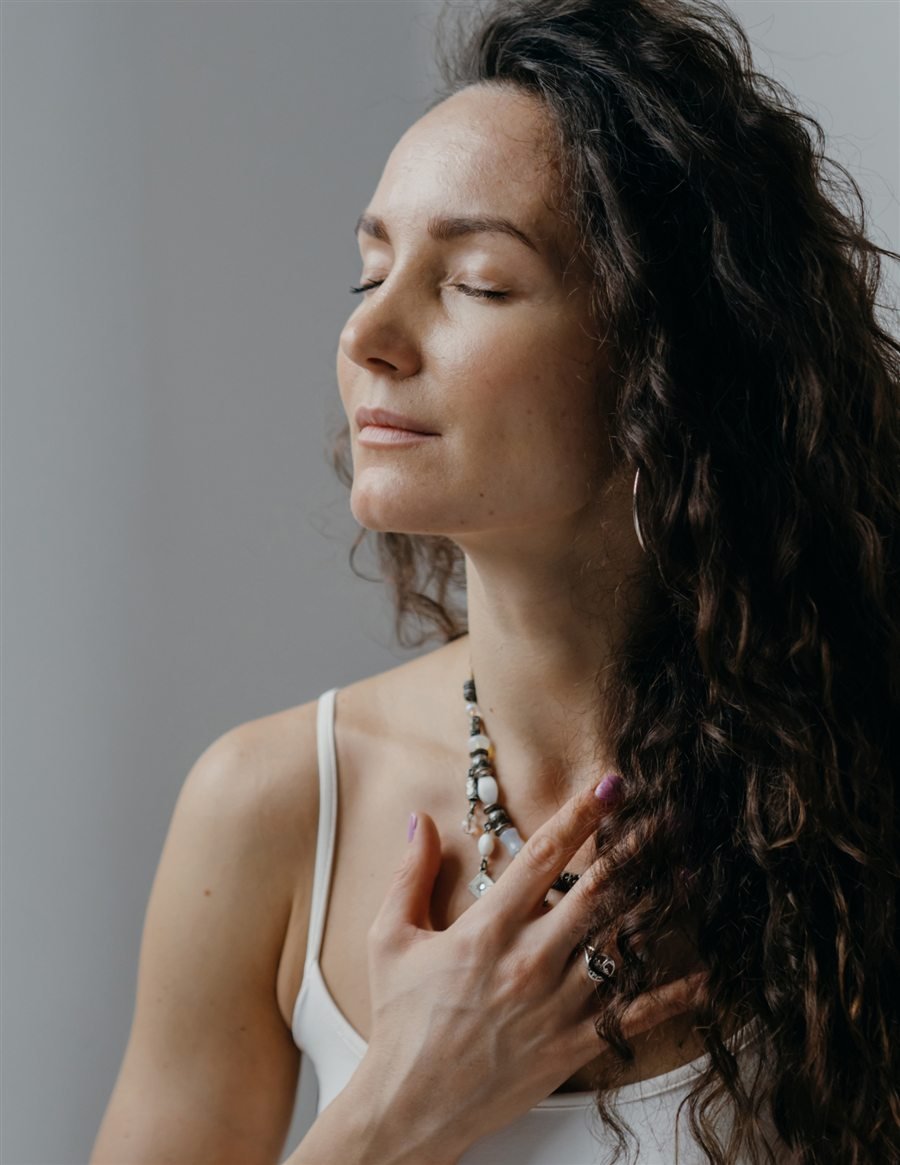
My first true connection with my heart came in my early twenties, when I began to study metaphysics seriously and to meditate seriously. I learned a meditation I still love. You find your pulse and feel your heart beating. Then you simply breathe, and with each breath you connect with your heart, as if you were breathing through it.

I practiced it for years, and nothing unusual ever happened. Then I moved to Chile.

I began to notice a strange sensation in my neck, as if a little air were caught there, as if I couldn’t quite breathe. In my family, we were taught not to make much of these things. “Don’t worry, child,” my mother always said. “It’ll go the same way it came.” So I let it go.

One night, lying in bed, I felt like meditating. I held my wrist, found my pulse, and waited. When that feeling came into my neck, I felt my heart skip a beat.

I froze. My father had died of a heart attack. For the first time in my life, I felt that I could die. It was terrifying.

I went to the doctor and did every test the heart requires. The conclusion: nothing serious. For a woman who had played sports all her life, he said, it was close to normal. I let go of the fear.

Many years later, I had a heart attack.

It was mild, and I didn’t recognize it. I thought my lungs were failing; I simply couldn’t breathe properly. Only the doctor told me what it was. I have often thought that if I had connected it to my father in that moment, the panic alone might have overwhelmed me. Instead, I survived.

And since that day, I have lived in close conversation with my heart.

A note from The TroveWhat Gillian felt, breathlessness rather than chest pain, is common in women’s heart attacks. If something feels wrong, don’t wait for it to go the way it came. Get checked.

Years before that, at a retreat, I heard one of the scientists from the HeartMath Institute speak. He explained that the heart’s field can be measured up to three feet from the body, and that when we speak to someone, heart meets heart. I remember being struck by how unaware we are of the field: not only the heart’s, but the field in general, and how our frequency goes out into the world.

It took me back to my youth. My brother had learned a healing modality that cleared the aura of negativity and of the energies that get stuck there. In those days I was very hyper, and he told me my aura was prickly. I thought that was incredible, that one could have a prickly aura. And it was true.

Whatever frequency, whatever vibration we carry, it shows up in the field around us. Through the heart, we send it out into the world.

I see the heart as the meeting place. In the tradition I practice, three energy centers sit below it and three above, and all of them meet in the heart. From there, what we carry is sent outward, and life answers with what we project.

This issue is about that space: the field around you, the science beginning to measure it, the sound and stone and copper people have used to feel it. The research is graded honestly, and the experiences honored for what they are.

So I leave you with this. Think of your heart as your connection, not only to spirit but to life itself. It is beating right now, on its own, without asking your permission. It has a nervous system of its own, thousands of neurons that scientists call the “little brain,” and in HeartMath’s words, it sends more to the brain than the brain sends to it. It is keeping you alive, and it is connecting you to the rest of the world.

When you meditate on your heart and breathe through it, I believe your aura grows, and your frequency becomes coherent.

HeartMath measures that coherence; see page 6. So try it tonight. Find your pulse. Feel your heart beating.

Breathe through your heart.

Gillian Parkinson F.Founder & Curator

The Trove · No. 05 · On Field2
The Trove · Issue No. 05 · November 2026 · Pillar IV: Field
In this issue
The heart, the cell, the earth and the ear: what has been measured, what is still emerging, and what is yours to feel.
  1. 02
    Editor’s letterListening to the heart
  2. 13
    The gardenCopper, coils and the electric harvest
  3. 04
    The practitionerLynne McTaggart
  4. 14
    HeritageThe copper our grandmothers trusted
  5. 05
    The lead featureThe heart is broadcasting
  6. 15
    PlaceThe stones that sing
  7. 07
    The deeper fieldAre we connected?
  8. 08
    Belief & biologyThe environment reads your genes
  9. 17
    Shop the issueThe field edit
  10. 09
    The sound featureBowls, water and bone
  11. 18
    DepartmentHHS & MAHA watch
  12. 11
    Editor-testedMy frequency shelf
  13. 19
    Next issueOn Spirit, in December
  14. 12
    Earth fieldThe planet’s heartbeat
How The Trove gradesFour labels · used on every claim
Solid

Replicated, mainstream science. You can build on it.

Emerging

Real, peer-reviewed work that is still early, small or narrow.

Experiential

People report it, often movingly. It has not been shown under controlled conditions.

Unsupported

Untested, or tested and contradicted by the evidence.

On the cover

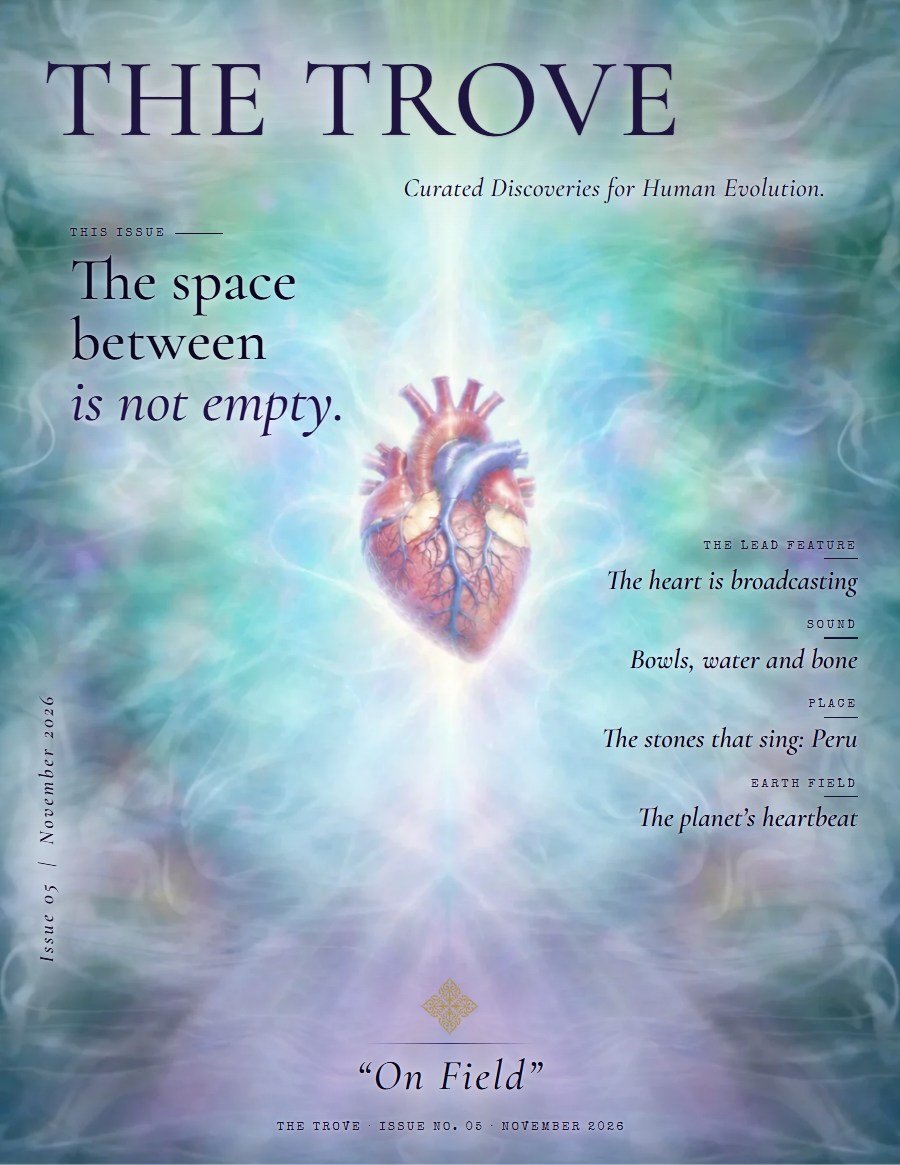
A human heart at the centre of its own field. How far that field really reaches is measured on page 5.

The Trove · No. 05 · On Field3
Before Christmas arrivesLet’s prepare to receive the Spirit of ChristmasA 21-day guided journal, December 1 to 21. $9.99, in English or Spanish. Choose your edition
Pillar IV · Field
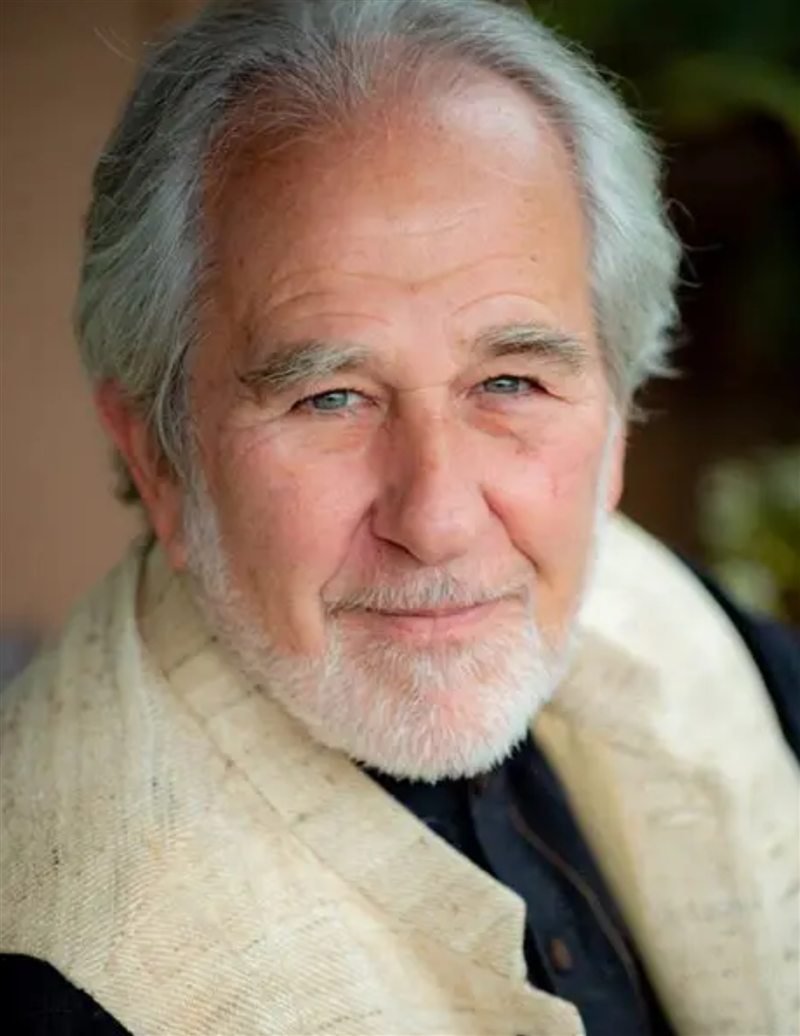
Lynne McTaggart, smiling, in a black turtleneck
Image: lynnemctaggart.com
Her books, in order
2001The Field
2007The Intention Experiment asked whether focused thought could affect the physical world.
2017The Power of Eight described small groups sending a shared intention.
2026The God Notes, due this month.
The practitioner
Lynne McTaggart
The woman who gave the field its name

In 2001, an American investigative journalist living in London published a book with a deceptively simple title: The Field. Lynne McTaggart had spent years interviewing physicists and biologists working at the edges of their disciplines. She came back with a single, sweeping idea. Underneath everything, there may be a sea of energy that connects us all: the quantum vacuum, or “zero-point field.”

That idea was not hers alone. What she did was give it a name ordinary people could hold. Twenty-five years later, “the field” is how millions of people talk about the space between things.

She did not stop at the book. In her small intention groups, participants reported healings, emotional breakthroughs and an unusual sense of connection.

38 of 42intention experiments showed a positive effect, by her own count. Her team ran and reported them.
She asked the question science keeps circling back to: are we separate, or are we in relationship with everything around us?
What The Trove grades
  • SolidCells emit faint light (biophotons). It is measurable and linked to metabolism.
  • UnsupportedThat light forms a coherent field that runs the body. This is the theory the book leans on, and researchers have not yet shown it.
  • SolidExperientialThe zero-point field is real physics. That it links our minds is what many people feel, and what no experiment has yet settled.
  • ExperientialGroup intention produces measurable effects. Her groups report it. No independent replication has been published yet.
Why she still belongs hereMcTaggart is a reporter of questions, not a laboratory. Her work brought physicists, biologists and readers into one room. The best way to read her is the way she writes: curious, and open to being proven wrong.

· lynnemctaggart.com, About (her count of experiments; The God Notes) · Publishers Weekly, review of The Field (HarperCollins, 2001) · Biophoton reviews: Front Physiol 2024 (PMC10899412); arXiv:1502.07316 · Critiques: M. Henderson, The Times; C. Orzel, physicist

The Trove · No. 05 · On Field4
The Trove · The lead feature · Pillar IV: Field
The heart is broadcasting
What the HeartMath Institute measured, and what it means for the way you breathe

Put a person in a magnetically shielded room with an instrument sensitive enough, and you can detect the heart’s magnetic field outside the body. The distance in the editor’s letter is HeartMath’s own published figure. It is real and measurable, and you may have heard much larger numbers repeated online.

The heart is the body’s strongest rhythmic source of electromagnetic energy.

HeartMath’s current figures
60×Electrical fieldits amplitude, against the brain’s
100×+Magnetic fieldits strength, against the brain’s
1/106And still faintabout a million times weaker than the Earth’s own field

The conversation runs upward

Most of the fibers in the vagus nerve carry information from the body to the brain, not the other way around. This is mainstream anatomy. In HeartMath’s words, “the heart sends more information to the brain than the brain sends to the heart.” Your heart rhythm is part of how your brain decides whether you are safe.

That makes the rhythm itself worth attention, and it is the one part of this story you can change tonight. Overleaf: what a calm rhythm looks like, and the two-minute practice that trains it.

The Trove · No. 05 · On Field5
The Trove · The heart is broadcasting · Continued
The rhythm you can train

Coherence. When we are frustrated, the space between heartbeats becomes jagged and erratic. When we breathe slowly and steadily, it becomes smooth and wavelike, rising and falling about once every ten seconds. HeartMath calls this state coherence. You can train it, and this is where the evidence is strongest. A 2017 meta-analysis of 24 studies found that heart rate variability (HRV) biofeedback produced a large reduction in stress and anxiety.

Frustrated · jagged, erraticCoherent · smooth, about one wave every ten seconds
The practice · two minutes, anywhere
Breathe with the heart
  1. Rest your attention in the center of your chest.
  2. Breathe in for about five seconds and out for about five seconds.
  3. On each breath, recall something or someone you genuinely appreciate.
  4. Stay with it for two minutes. Notice what changes.
What The Trove grades
  • SolidThe heart produces a measurable field.
  • Solidto EmergingSlow breathing and HRV training reduce stress. The effect is strong, though mostly self-reported.
  • EmergingEarth’s magnetic activity syncs with human heart rhythms. The studies are small and mostly by HeartMath-affiliated researchers.
  • ExperientialYour heart’s field changes the people near you; group coherence calms the planet. HeartMath itself calls the planetary idea a hypothesis, and the one outside case study found no effect.

Shop the feature: the HeartMath Inner Balance sensor, in The field edit, page 17.

Sources

· HeartMath Institute, Science of the Heart: Energetic communication; Heart–brain communication; Coherence (heartmath.org) · Goessl VC, Curtiss JE, Hofmann SG. The effect of heart rate variability biofeedback training on stress and anxiety: a meta-analysis. Psychol Med 2017;47:2578–86 · Magnetocardiography and field strength: review, PMC10181075 · Alabdulgader A, McCraty R, et al. Sci Rep 2018 (geomagnetic activity and HRV) · HeartMath, Global Coherence Initiative (hypothesis statement) · Edwards SD. IJERPH 2019, PMC6480448 (single case study)

The Trove · No. 05 · On Field6
The Trove · The deeper field · Pillar IV: Field
Are we connected?
The people who went looking, and what they found
A group standing together among ferns, eyes closed, hands on their hearts

I believe the field is real, and that we are connected.

Gillian Parkinson F. · Editor

In the summer of 1993, about 4,000 people came to Washington, D.C., to sit together in silence. They came to test an old and tender idea: that what we carry inside does not stop at the skin.

The summer Washington sat still. From June 7 to July 30, they meditated in groups. As the group grew, homicide, rape and assault fell against the researchers’ model, by as much as 23.3% in the final week, when the group was largest. Robbery did not change. The study was published in 1999. Its authors belong to the Transcendental Meditation movement, skeptics mocked it with an Ig Nobel prize, and no independent team has repeated it. Still, someone had the courage to measure.

Seven days with Dr. Joe. In 2025, a University of California San Diego team followed 20 healthy adults through a week-long retreat led by Joe Dispenza. Brain scans showed quieter activity in the regions of mental chatter. In the blood, gene activity shifted and the body’s own pain-relieving opioids rose. Lab-grown neurons bathed in their plasma grew longer branches. There was no control group, and Dispenza, a co-author, works for the company that offers the retreat.

The quiet network. Since 1998, Roger Nelson’s Global Consciousness Project has kept random-number generators running around the world, and his team reports that they stray from chance when humanity shares a great moment. Skeptics dispute it. Gregg Braden’s The Divine Matrix gathers experiments like these into one picture. They have not been replicated, and we read him closely in Issue 06.

What The Trove grades
  • EmergingGroup meditation lowers violent crime. One large published study, not yet independently repeated.
  • EmergingA meditation retreat changes brain and blood. Twenty people, no control group.
  • ExperientialA field connects us all. Traditions and many people report it. Researchers are looking, and none has settled it.
Sources

· Hagelin JS, et al. Effects of group practice of the Transcendental Meditation program on preventing violent crime in Washington, D.C. Soc Indic Res 1999;47:153–201 · Jinich-Diamant A, et al. Neural and molecular changes during a mind-body reconceptualization, meditation, and open label placebo healing intervention. Commun Biol 2025; UC San Diego release · Bancel P, Nelson R. The GCP event experiment. J Sci Explor 2008 · Braden G. The Divine Matrix, 2007

The Trove · No. 05 · On Field7
The Trove · Belief & biology · Pillar IV: Field
The environment reads your genes
Bruce Lipton, epigenetics, and where the science stops

In 2005, cell biologist Bruce Lipton published The Biology of Belief. Its central idea landed like a release: you are not a prisoner of your genes. Genes are switched on and off by their environment, and that environment includes the signals of your own mind. Half of that is now textbook biology.

The yellow mouse. In 2003, researchers at Duke fed pregnant mice a diet rich in folic acid, B12 and choline. The pups were genetically identical to yellow, obese, disease-prone mice. Yet many were born brown, lean and healthy. Their DNA had not changed; the nutrients had changed which genes were switched on.

The hunger winter. People conceived during the Dutch famine of 1944–45 still carried measurable gene-marking differences six decades later, compared with their own siblings.

Diet, stress, sleep, smoking and movement all shift gene expression. This is epigenetics, and it is solid science.

Where Lipton goes further. Lipton argues that beliefs and thoughts directly reprogram our genes. That full step has not been shown, though early studies of meditation are beginning to see gene activity shift (page 7). The mouse study was about food, and the famine study was about hunger, not belief. What is well established is the indirect route: chronic stress changes hormones, inflammation and immunity, and those change the body.

What The Trove grades
  • SolidEnvironment changes gene expression.
  • SolidStress and calm shape health through hormones and immunity.
  • EmergingMeditation shifts gene activity. Early and small.
  • UnsupportedBelief alone rewrites DNA.
The practical truth is still freeing

You cannot think your way out of your genes. But you can feed, rest, move and calm your way into different gene expression, and that is within your reach today.

Sources

· Lipton BH. The Biology of Belief, 2005 · Waterland RA, Jirtle RL. Transposable elements: targets for early nutritional effects on epigenetic gene regulation. Mol Cell Biol 2003;23:5293–300 · Duke Health news release, 2003 · Heijmans BT, et al. Persistent epigenetic differences associated with prenatal exposure to famine in humans. PNAS 2008;105:17046–49

The Trove · No. 05 · On Field8
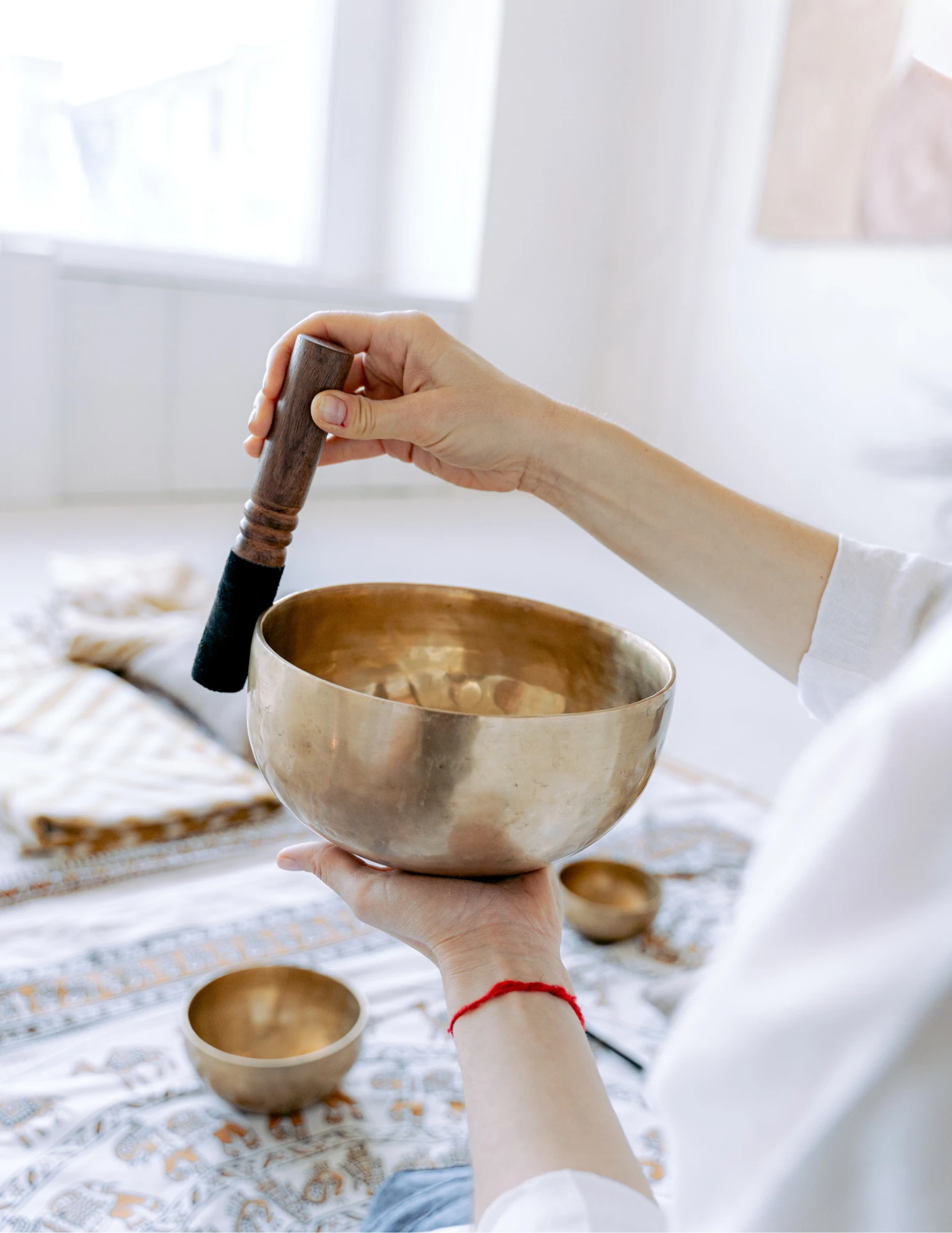
A woman in white holds a bronze singing bowl on her open hand and raises its mallet to the rim
The Trove · The sound feature · Pillar IV: Field
Bowls, water and bone
What happens to the body when metal sings
The sound is real. The calm is real. The size of the effect is still being measured.

Strike a singing bowl and something unusual happens in the room. The tone does not stop; it widens. Then, beneath the main note, a second and third tone rise out of the metal. A singing bowl is technically a standing bell: its rim vibrates in waves, and every wave carries overtones.

The bowls. Metal bowls from the Himalayan region are hand-hammered bronze. Their exact history is less documented than the stories told about them, and serious researchers still debate when they entered ritual use. Crystal bowls are a modern invention. In the mid-1980s, quartz crucibles discarded by the semiconductor industry were found to sing when played, and a new instrument was born from computer manufacturing.

What the research says. In a 2016 study, 62 adults lay through a single singing-bowl session. Afterward they reported significantly less tension, anger, fatigue and low mood. People new to the practice felt the biggest drop in tension. It is a promising result, but the study had no comparison group. A 2025 review of 14 studies found the same pattern of short-term calm. The reviewers could not yet pool the results, and they called for better trials.

When water dances. Fill a bowl with water and play it, and the surface comes alive. Ripples form in a star pattern around the rim. Play harder and droplets leap from the edge and bounce across the water. In 2011, physicists at MIT described exactly this as Faraday waves: vibration organizing liquid into patterns. In the 1960s, Swiss physician Hans Jenny filmed sand, paste and fluids forming geometric shapes under sound, and he named the field cymatics. Vibration shapes matter; that part is physics.

The Trove · No. 05 · On Field9
The Trove · Bowls, water and bone · Continued
Standing in the sound

Many people drink the water afterward, as a way of taking the sound inward. We love this as a ritual: a pause, an intention, a glass of water. There is no evidence that the water itself changes. Masaru Emoto’s famous water-crystal photographs were never blinded, and when a triple-blind test was finally run, the result was negative. Drink it for the ritual, and for hydration.

Standing in the bowl. Some sound studios now offer a giant bowl, large enough to stand in, that is struck while you are inside it. The vibration travels up through the soles of your feet. The best-known maker, Meinl, calls them the Grounding series; they are hand-hammered bronze and weigh up to 14 kg. No study has yet tested standing in a bowl. Research on vibroacoustic therapy, low-frequency vibration delivered to the body, is early but growing, especially for pain. This is one to experience with an open mind and a qualified practitioner.

The pillow of steel. The instrument shaped like a flattened egg is the handpan. Its ancestor, the Hang, was created in 2000 in Bern, Switzerland, by Felix Rohner and Sabina Schärer of PANArt; “Hang” means “hand” in the local dialect. A central note, the “ding,” is surrounded by hammered tone fields, each tuned to a scale. A good handpan takes 20 to 40 hours or more to make by hand, and it sounds like it. For a beginner, the steel tongue drum is its affordable cousin. It was invented in 2007 by a man who first cut one from a propane tank.

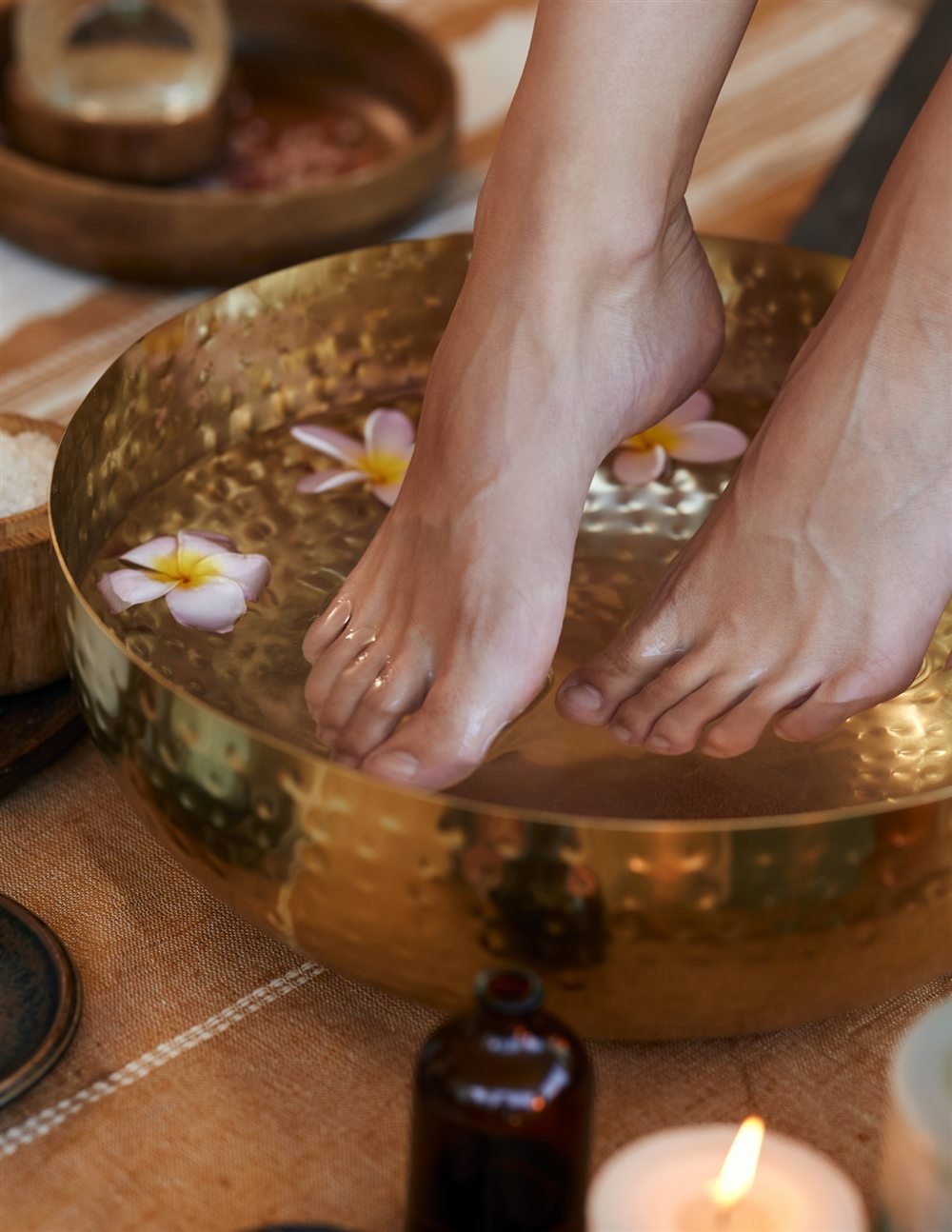
Bare feet resting in a wide hammered bronze bowl with flowers, a candle beside it
What The Trove grades
  • EmergingSinging bowls ease tension and lift mood. The results are consistent but the studies are small.
  • UnsupportedBowl-played water gains healing properties. It is beautiful as ritual.
  • SolidWater forms patterns under vibration. This is physics.
  • ExperientialStanding-bowl vibration. It has not been studied directly.
  • EmergingVibration therapy for pain.
Sources

· Goldsby TL, et al. Effects of singing bowl sound meditation on mood, tension, and well-being. J Evid Based Complementary Altern Med 2017;22:401–06 · Lin, Yang & Wang. Systematic review of singing bowl research. Healthcare 2025;13:2002 · Terwagne D, Bush JWM. Tibetan singing bowls. Nonlinearity 2011;24:R51–R66 · Jenny H. Kymatik, 1967 · Radin D, et al. Triple-blind test of intention on water crystals. J Sci Explor 2008 · Vibroacoustic therapy scoping review, BMJ Open 2022;12:e046591 · Records (not research): O. Marshall on crystal bowls, oral histories; Meinl Sonic Energy, Grounding series; PANArt and the Hang; D. Havlena, the hank drum, 2007

The Trove · No. 05 · On Field10
The Trove · Editor-tested · Pillar IV: Field
My frequency shelf
Two tools, used at home, by the editor
Tested by Gillian · her experience, not a health claim
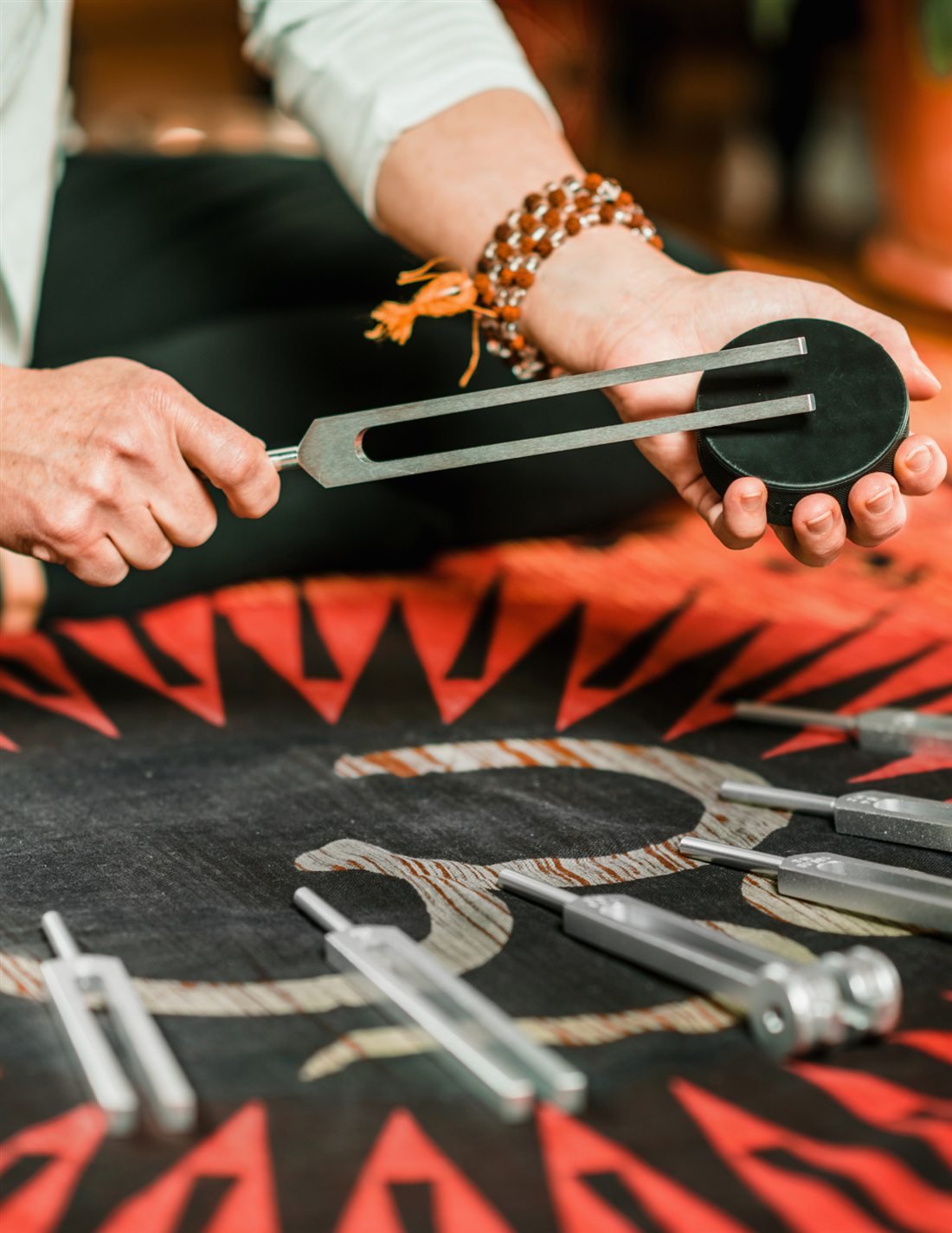
I own two frequency tools, and I have lived with both long enough to know the difference. One I reach for every day. The other taught me something about rituals.

Hands holding a steel tuning fork above a set of forks on a patterned cloth
The one I reach for

The 528 Hz tuning fork

Mine is a simple steel fork, nothing precious. I strike it and rest the stem on my sternum, or near the place that aches, and I let the hum travel through the bone. I love this fork. I love how it feels against the bone and against the skin, and I do feel better when I use it. It needs no batteries, no app and no setup.

The Trove’s noteThe 528 Hz “love frequency” and “DNA repair” claims trace back to a 1990s book, not a laboratory. One tiny 2018 pilot study, with nine people, found lower stress hormones after music tuned to 528 Hz. That result is interesting, but it has not been repeated. What is well documented: vibration on the skin can quiet pain signals. It is the same reason we rub a bumped elbow. Gillian’s experience is hers, and we print it as that.
Experiential
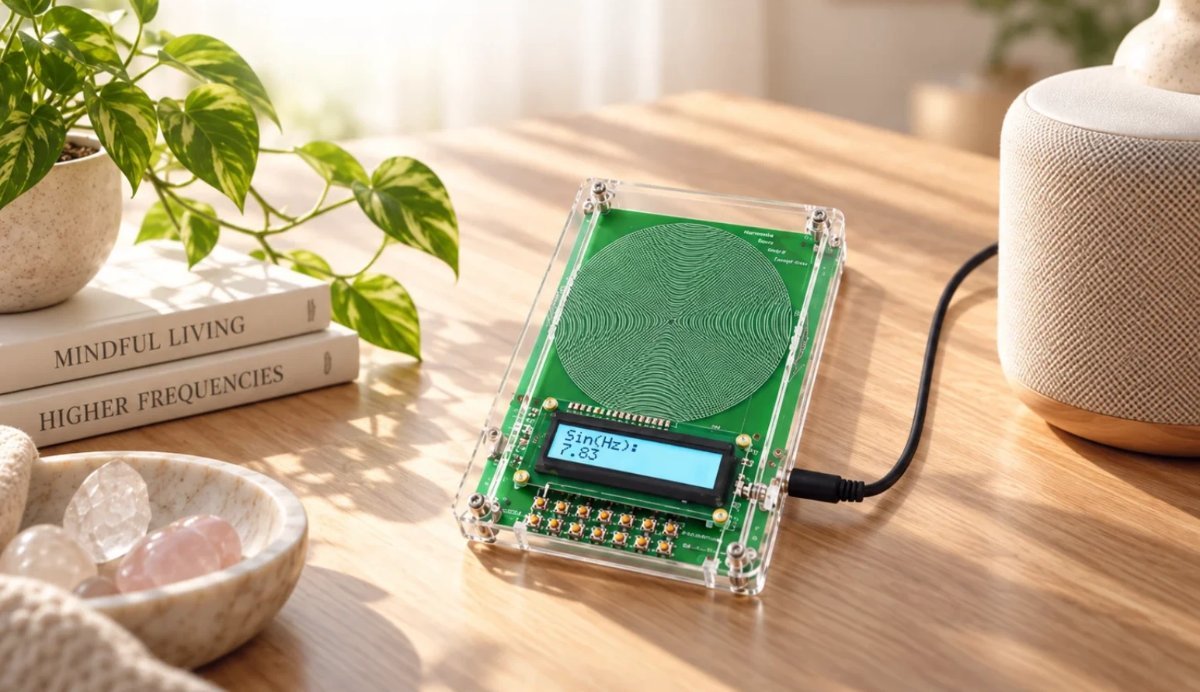
The Bexxly Harmonia, a frequency device with a green coil board and a screen reading 7.83 Hz, on a sunlit wooden table
Pure tone, real friction

The Bexxly Harmonia

My Bexxly Harmonia produces a clean, pure tone, and I love the sound. But a device only works if you use it, and this one asks for a ritual: a set place, a chosen frequency, and headphones. The truth is, the ritual is where I stumble, and it sits unused more often than I would like.

What I am doing about it: giving it one home (my nightstand) and one job (a 15-minute wind-down before sleep, with soft sleep headphones). I will tell you how it goes.

The Trove’s noteFrequency devices are not medical devices, and none has been approved to treat any condition. We describe how it feels. We make no health claims for it.

If it is not easy, build a ritual around it, or let it go.My rule for frequency tools

Sources

· Akimoto K, et al. Effect of 528 Hz music on the endocrine system and autonomic nervous system. Health 2018;10:1159–70 (9 adults, pilot) · Vibration anesthesia during invasive procedures: a meta-analysis, J Clin Aesthet Dermatol · On the 528 Hz claim’s origin: L. Horowitz, Healing Codes for the Biological Apocalypse (book, not research) · FTC and FDA statements on frequency generators

The Trove · No. 05 · On Field11
The Trove · Earth field · Pillar IV: Field
The planet’s heartbeat
The Schumann resonance, and the ground beneath your feet
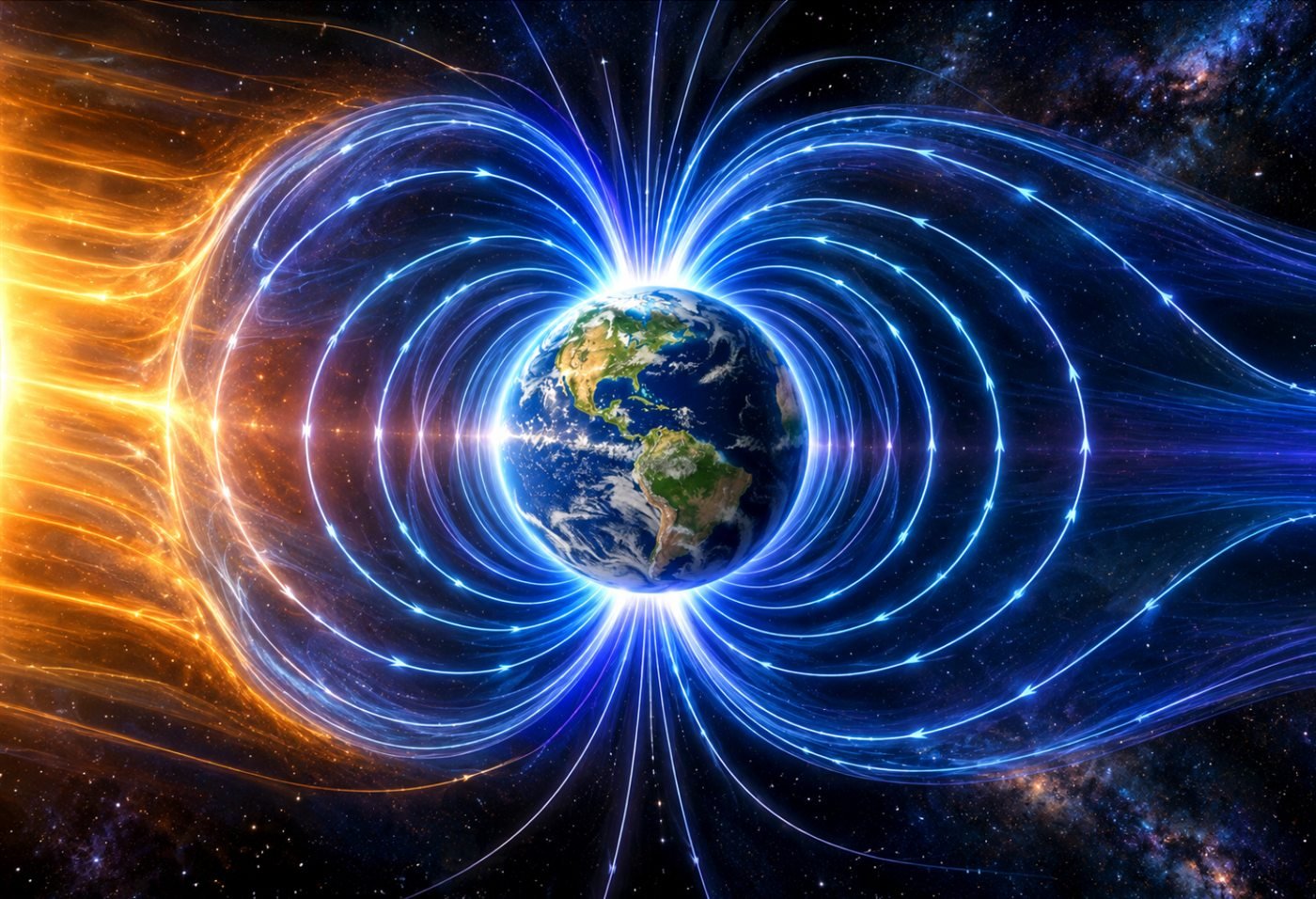
The Earth inside the blue arcs of its magnetic field, with the solar wind streaming in
7.83HzThe deepest tone · cycles per second
Higher modes, near14.32026

Lightning strikes somewhere on Earth every moment. Together, those strikes ring the space between the ground and the upper atmosphere like a bell. That ringing, the planet’s heartbeat, is the Schumann resonance, predicted by physicist W. O. Schumann in 1952 and measured soon after.

It is real, and it is faint. Claims that it is “rising” do not hold up, and “Schumann resonators” have no clinical evidence. But whether it touches the body is a real question, and researchers are asking it.

The heart and the hum. In 2017, HeartMath scientists and colleagues followed nine people for a month. Their slow heart rhythms moved with the strength of the resonance. Other small studies report brain waves tracking it too.

Barefoot. Earthing has become a movement around the world, and the research is growing. Double-blind trials, using sham mats for comparison, have reported better sleep and less pain. Most are small, and some researchers have ties to grounding companies.

Nature. Here the evidence is strongest. Pooled studies find lower cortisol and blood pressure in the forest, and among nearly 20,000 people in England, two hours a week in nature went with better health and wellbeing.

Negative ions. A review of 33 studies found that high doses lowered depression scores, though it found no consistent effect on anxiety, mood or sleep.

What The Trove grades
  • SolidThe Schumann resonance exists.
  • SolidTime in nature lowers stress.
  • EmergingHeart rhythms and brain waves move with it.
  • EmergingEarthing improves sleep and pain.
  • EmergingNegative ions ease depression at high doses.
  • ExperientialBarefoot, we tune to the planet’s frequency.
Grounding (earthing)We graded it in detail: PEMF and grounding, read honestlyRead the article →
The planet hums. Take off your shoes and go outside.
Sources

· Schumann WO. Z Naturforsch A 1952 · Schumann resonance review, Front Astron Space Sci 2023, doi:10.3389/fspas.2023.1162624 · McCraty R, et al. Synchronization of human autonomic nervous system rhythms with geomagnetic activity. Int J Environ Res Public Health 2017;14:770 · Persinger MA and colleagues, EEG and Schumann coherence studies · Park HJ, et al. Earthing mat and sleep. Adv Integr Med 2025;12:100458 · Chevalier G, et al. Grounding and bodyworkers’ pain. Explore 2019 · Antonelli M, et al. Forest bathing and cortisol. Int J Biometeorol 2019 · Ideno Y, et al. Forest bathing and blood pressure. BMC Complement Altern Med 2017 · White MP, et al. Sci Rep 2019 · Perez V, et al. Air ions and mood. BMC Psychiatry 2013

The Trove · No. 05 · On Field12
The Trove · The garden · Pillar IV: Field
Copper, coils and the electric harvest
A 120-year-old experiment, back on social media

Scroll through gardening videos this year and you will see copper wire wound into spirals and pushed into the soil like small antennas. The promise: they draw energy from the atmosphere, and the vegetables grow larger. The idea is called electroculture, and it is older than you might think.

The history is real. In 1904, Finnish physicist Selim Lemström published Electricity in Agriculture and Horticulture. He strung electrically charged wires over crops and reported larger harvests. In the 1920s, a French baker-turned-inventor, Justin Christofleau, patented a device to “capture atmospheric electricity” for fields. Britain even ran an official Electro-Culture Committee. It closed in 1936 without reliable results.

What modern testing shows. No controlled study has shown that copper coils increase yields. Horticulturists at Washington State University Extension call the claim unsupported and the mechanism implausible. As for copper tape against slugs, the Royal Horticultural Society tested it on 108 lettuces and found no difference in damage.

Where copper really works on farms. Copper is a long-approved fungicide, sprayed against blight and mildew, including on organic farms. It comes with a cost: it builds up in soil and can harm earthworms and soil fungi, so its use is limited by regulation.

Wonder is not the same as evidence. The garden is where you can test the difference yourself.
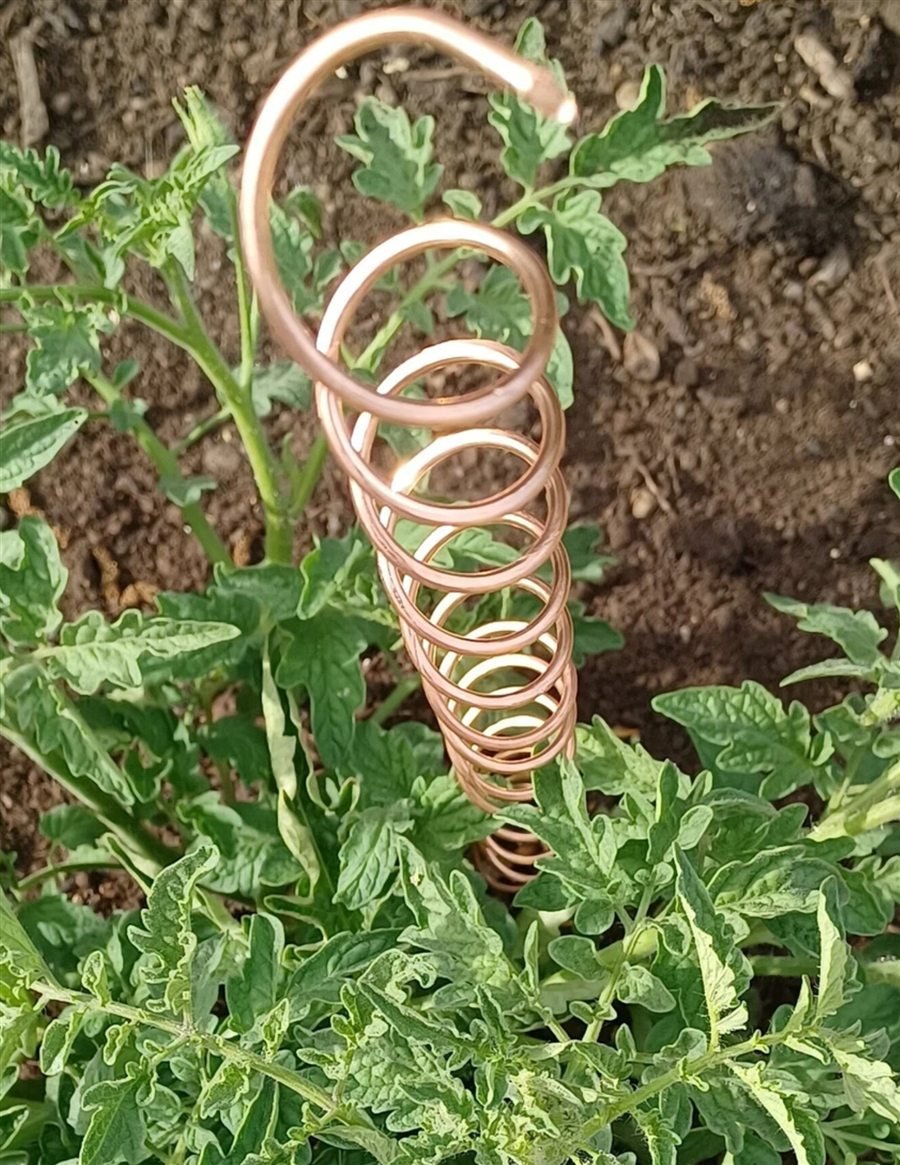
A copper spiral coil on a stake among tomato plants
Try it · The Trove garden test

Plant two beds side by side, with the same soil, the same seed and the same water. Put a copper coil in one only. Weigh the harvest. Send us your results; we will publish the best ones.

What The Trove grades
  • SolidThe history of electroculture.
  • UnsupportedCopper tape stops slugs in real gardens.
  • UnsupportedCopper coils boost growth.
  • SolidCopper fungicides, with real costs to soil life.
Sources

· Lemström S. Electricity in Agriculture and Horticulture, London, 1904 · Christofleau J. Swiss patent CH118648A, 1927 · Garden Trust and University of Warwick histories of the Electro-Culture Committee · Chalker-Scott L. Washington State University Extension and The Garden Professors · Royal Horticultural Society, slug and snail barrier trial, RHS Wisley · USDA National Organic Standards Board, fixed coppers; 7 CFR 205.601 · EU Regulation 2018/1981

The Trove · No. 05 · On Field13
The Trove · Heritage · Pillar IV: Field
The copper our grandmothers trusted

In many Latin American homes there was a copper bracelet on a grandmother’s wrist, and a copper pot no one was allowed to scrub too hard. In India, Ayurveda has long taught tamra jal: water left overnight in a copper vessel and drunk in the morning. Two continents, one instinct: copper is protective.

The tradition has a scientific core. Copper surfaces kill bacteria on contact. In 2008, the US Environmental Protection Agency registered copper alloys as antimicrobial touch surfaces: rails, handles, counters. In a 2012 study inspired by Ayurveda, water contaminated with disease-causing bacteria and stored in copper pots for 16 hours tested clean. The copper that dissolved into it stayed well under safety limits.

Time is the key. Every study that found copper cleaning water needed hours of contact, from overnight to two days. No study has tested the small copper sticks sold for water bottles. Think of copper as a slow, overnight ritual, not instant purification on the go.

Copper protects slowly. Ritual is the point, and patience is the method.

The bracelet. Copper and magnetic bracelets have been tested in careful trials, for both rheumatoid and osteoarthritis. They worked no better than placebo bracelets. We still love them, as heirlooms, as beauty, and as a daily reminder to care for the body. We simply will not promise they treat pain.

How to use copper for water safely
  • Plain water only, never lemon water, juice or anything acidic, which pulls too much copper into the drink.
  • Leave it overnight in a copper vessel at room temperature, and never with hot drinks.
  • Clean it with lemon and salt, then rinse well, so tarnish does not build up.
  • Not for people with Wilson’s disease or a copper-related condition. Ask your doctor if unsure.
  • Magnetic jewelry: not for anyone with a pacemaker or insulin pump.
What The Trove grades
  • SolidCopper surfaces kill bacteria.
  • EmergingWater stored in copper overnight is cleaner. The lab studies are consistent but small.
  • UnsupportedA copper stick purifies water in your bottle.
  • UnsupportedCopper or magnetic bracelets relieve arthritis pain.
  • ExperientialTamra jal as a morning ritual. It is a beautiful tradition.
Copper and Latin America
ChileEl sueldo de Chile

Copper was called the country’s salary, and the industry was nationalized in 1971.

Michoacán, MexicoSanta Clara del Cobre

The Purépecha town has hammered copper by hand for centuries.

CubaLa Caridad del Cobre

The patron saint is Our Lady of Charity of Copper.

Sources

· Sudha VBP, et al. Storing drinking-water in copper pots kills contaminating diarrhoeagenic bacteria. J Health Popul Nutr 2012;30:17–21 · US EPA registration of antimicrobial copper alloys, 2008 · Grass G, Rensing C, Solioz M. Metallic copper as an antimicrobial surface. Appl Environ Microbiol 2011;77:1541–47 · Arora et al. J Water Process Eng 2022;50:103302 · Richmond SJ, et al. PLoS One 2013;8:e71529 · Richmond SJ, et al. Complement Ther Med 2009;17:249–56 · WHO, copper chemical fact sheet · FDA Food Code 4-101.14 · NIDDK, Wilson disease · NCCIH, magnets · Chile Law 17.450 (1971) · Santa Clara del Cobre and El Cobre: historical records

The Trove · No. 05 · On Field14
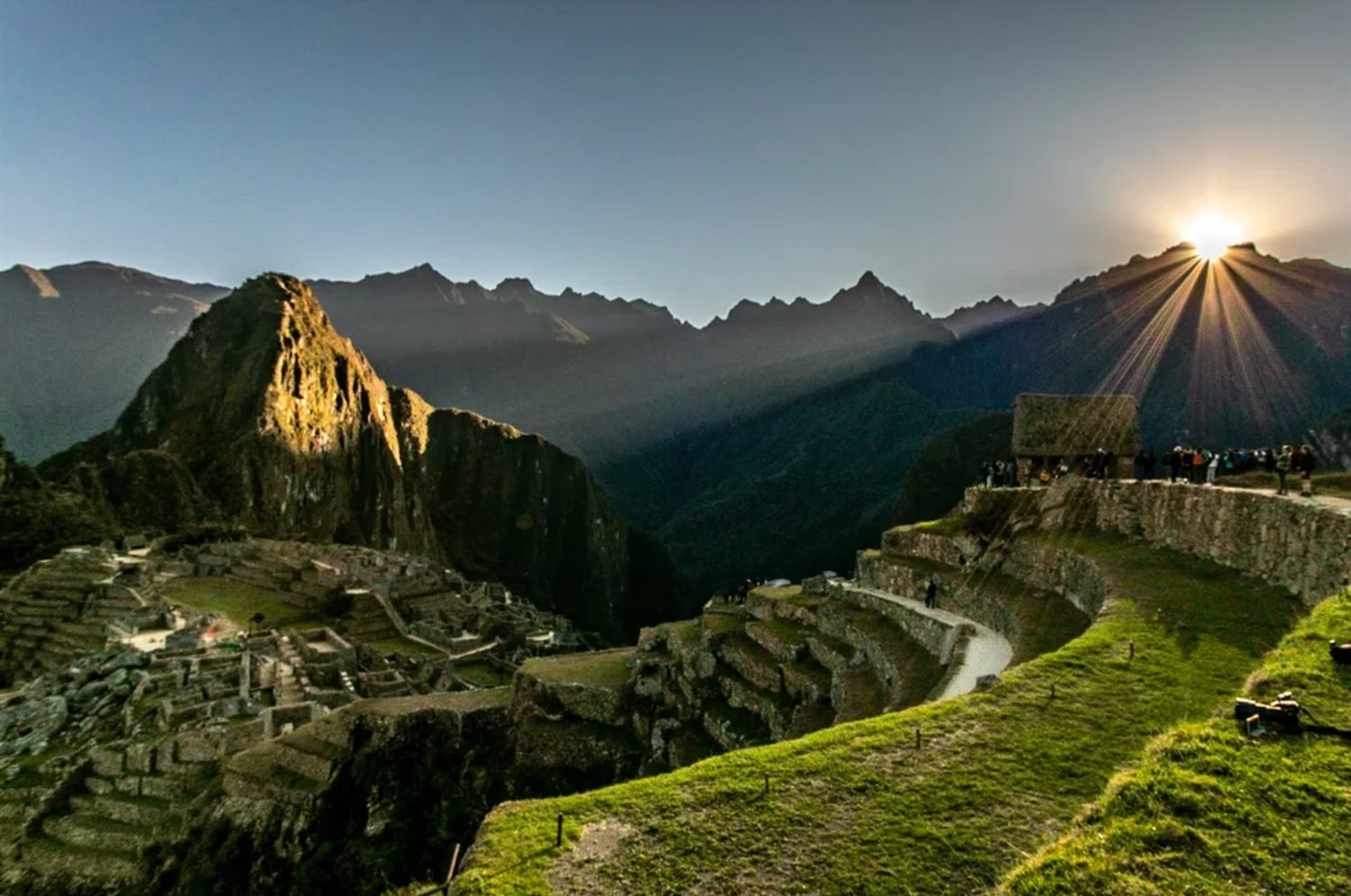
The sun rising behind the peaks over Machu Picchu's terraces
The Trove · Place · Pillar IV: Field
The stones that sing
What scientists have actually measured in the sacred places of Peru

Ask anyone who has stood at Machu Picchu at dawn and they will tell you the same thing. Something there is felt before it is understood. The mountains close in, the clouds lift off the river, and the silence seems to have a texture.

Peru has drawn seekers for a century with stories of energy, vortexes and stones that hum. Some of those stories are folklore. But some of the most remarkable sound-and-field science anywhere in the world comes from these mountains, and it is more surprising than the legends.

The temple that played with sound. Three thousand years ago, long before the Inca, people gathered at Chavín de Huántar, a ceremonial center in the northern Andes. In 2001, excavators working in its underground stone galleries found about twenty decorated conch-shell trumpets, called pututus. The shells came from the tropical coast, at least 500 miles away. They still play.

Stanford acoustician Miriam Kolar spent years measuring those galleries with speakers and microphones. Echoes arrive from many directions at once, so in the dark a listener cannot tell where a sound is coming from. Certain ducts strengthen the trumpets’ notes. Two shells played at close pitches create a slow, throbbing pulse, felt in the body as much as heard. Lead archaeologist John Rick calls it “extraordinarily likely” that sound there was used on purpose.

The music is older still. At Caral, the oldest known city in the Americas, archaeologists found 32 flutes carved from condor and pelican bone, about 5,000 years old. In the Andes, sound and ceremony have been partners for five millennia.

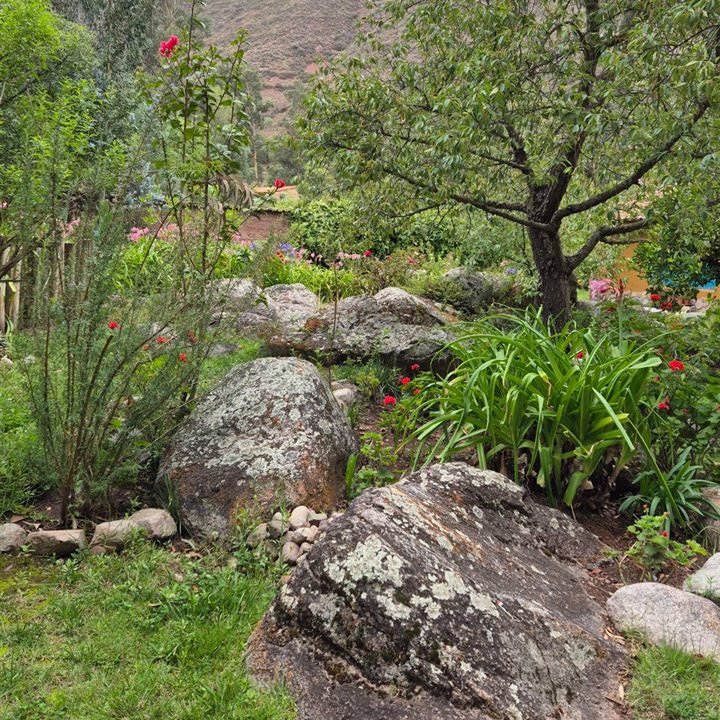
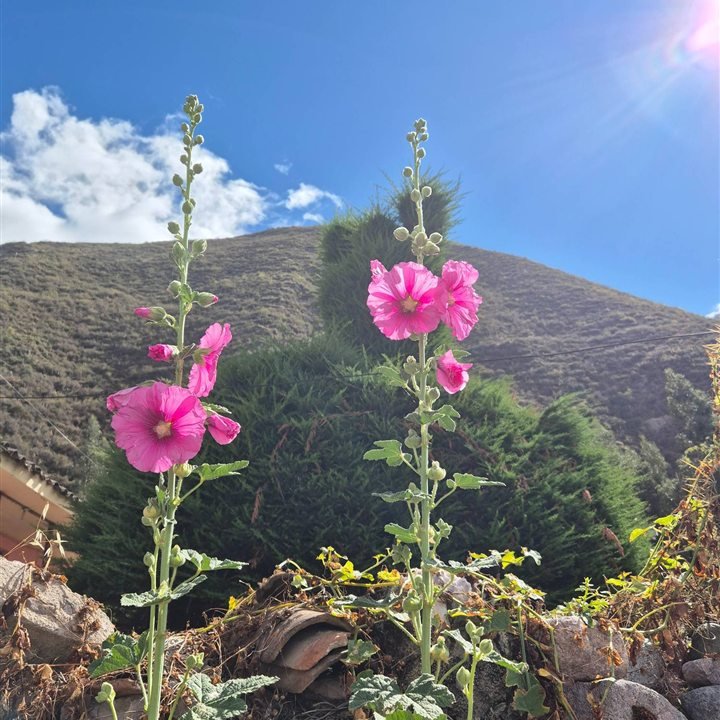
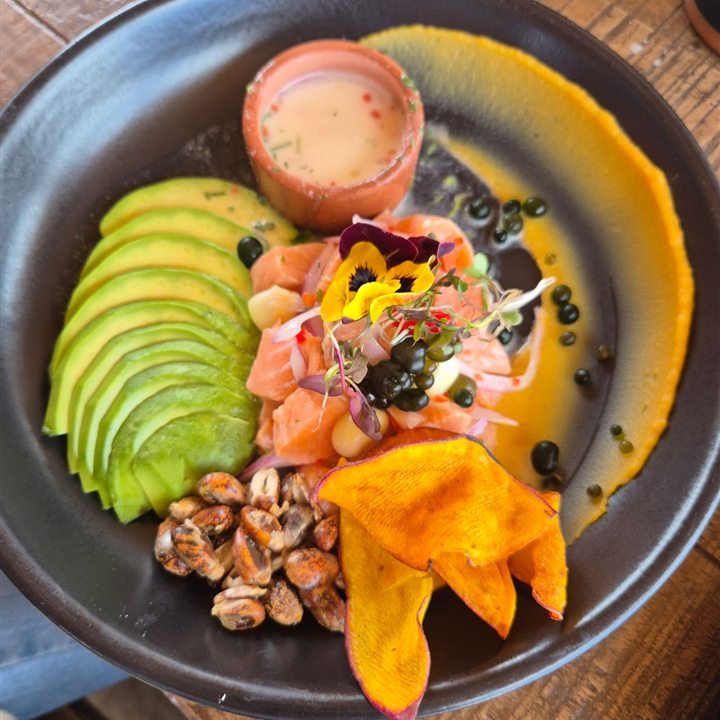
Llamas on a high plain below snow-capped Andean peaksA garden of lichened boulders and flowers below terraced hillsPink hollyhocks against a green hillside and blue skyA plate of Peruvian ceviche with avocado, toasted corn and sweet potato
Photographs courtesy of Evy Y. Parkinson
The Trove · No. 05 · On Field15
The Trove · The stones that sing · Continued
Built where the mountains break

Built on breaking ground. In 2019, geologist Rualdo Menegat showed that Machu Picchu sits where two sets of fault lines cross in an X. The cracked granite gave the Inca a ready supply of building stone, and natural channels to drain the heavy mountain rain. Ollantaytambo, Pisac and Cusco sit on fault crossings too. “Machu Picchu’s location is not a coincidence,” Menegat said. Researchers have since logged more than 140 marks of earthquake damage in its temples, from at least two strong quakes during construction. The Inca built on moving ground, and their walls are still standing.

Rooms tuned to the sun. In the Torreón, the Temple of the Sun, the June-solstice sunrise shines through the center of one window. In Intimachay, a shaped cave below, the rising sun enters only around the December solstice. These are measured, published alignments: architecture in conversation with the sky.

The field as a relationship. The Andean world has its own word for the field we keep trying to name. Ayni means reciprocity: give and receive, and keep the exchange alive. Mountains are apus, living beings. Offerings to them and to Pachamama, Mother Earth, are still made today, including by the crews who maintain the trails at Machu Picchu. In this view, power is not taken from a place. It lives in a relationship with it.

What has not been measured. No published study has measured a “frequency” or “vibration” at Machu Picchu. The famous claims, such as compasses spinning at the Intihuatana stone, energy readings on pendulum scales, and aura photographs of visitors, rest on no valid measurement. What visitors feel there is real and widely shared, and we honor it as experience. The Intihuatana itself has a quieter, true story: in 2000, a crane filming a beer commercial fell and chipped it. Visitors may no longer touch the stone.

The real field beneath Machu Picchu is the earth itself.
If you go
FirstSacred Valleysleep lower first
Then2,430 mMachu Picchu
Last3,350 mCusco · about 11,000 feet
AltitudeClimb gradually, in the order above, so the body can adjust.
TicketsIn 2026, entry is capped at 4,500 to 5,600 visitors a day, with fixed circuits and timed tickets from the official site, tuboleto.cultura.pe.
RespectPay local guides fairly, ask before photographing people, and leave the carved stones untouched.
What The Trove grades
  • SolidChavín’s galleries shape sound. They have been measured.
  • SolidThe solstice windows.
  • EmergingThe temple was designed for those effects.
  • ExperientialThe site’s “high vibration.”
  • EmergingMachu Picchu was built on crossing faults. It was presented in 2019, from long fieldwork.
  • UnsupportedMeasured energy readings at the site.
Sources

· Archaeology, “Listening to the gods of ancient Peru” · Kolar M. Chavín de Huántar acoustics, Acoustical Society of America (acoustics.org) · The Met, “Music in the ancient Andes” · Archaeology, Machu Picchu built on faults, Sept 25, 2019 · University of Oxford Earth Sciences, earthquakes at Machu Picchu, 2019 · Intimachay: a December solstice observatory at Machu Picchu, American Antiquity · Smithsonian NMAI, reciprocity (ayni) · Archaeology, Intihuatana damage, 2000 · CDC Yellow Book, high-altitude travel · Peru Ministry of Culture, 2026 visitor caps (285-2025-MC)

The Trove · No. 05 · On Field16
Evy Y. Parkinson, retreat leader You are invited · March 22–29, 2027Come with us to the Sacred ValleyA Healing & Culture Retreat for Women. Eight days of yoga, qigong and creative writing, with a day at Machu Picchu, led by Evy Y. Parkinson.Evy Y. Parkinson is a member of the editor’s family. See the itinerary
The Trove · Shop the issue · Pillar IV: Field
The field edit
Two tools we would stand behind, and the journal we made for you

DisclosureEvery product we feature has been researched, not personally tested, unless we say so. No link on this page earns The Trove a commission: each is marked “Direct, no commission.” Prices are approximate, as researched in October 2026; check before you buy.

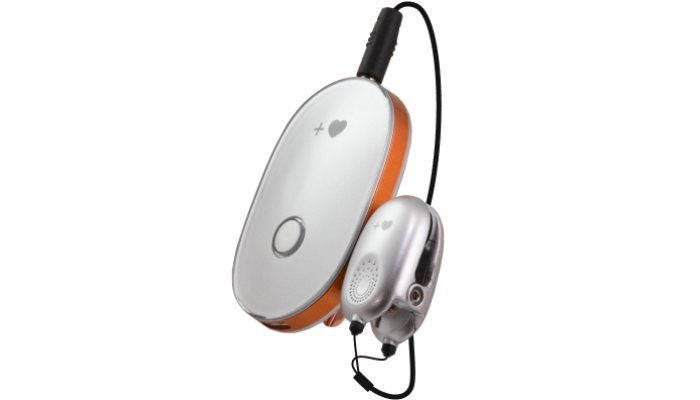
The HeartMath Inner Balance sensor with its ear clip
From the lead feature
HeartMath Inner Balance

A sensor and app that show your heart rhythm as you practice the breath on page 6. Heart-rhythm training has the strongest evidence in this issue: 24 studies pooled in 2017 found less stress and anxiety.

About $249Visit →
Direct, no commission · Image: HeartMath
A bronze singing bowl, mallet and mala beads on a woven mat by the sea
From the sound feature
A Himalayan metal bowl

Hand-hammered, small enough for a shelf and a daily minute of sound. The studies are small but consistent: people report less tension after a session.

About $65–125Shanti Bowl →
Direct, no commission
The cover of The Spirit of Christmas Before Christmas arrives Let’s prepare to receive the Spirit of Christmas My own 21-day guided journal, December 1 to 21. To release, to ask, and to receive. In English or Spanish. $9.99 · PDFChoose your edition The Trove’s own product. This one we do earn from.
The Trove · No. 05 · On Field17
The Trove · Department · Policy, read calmly · As of October 31, 2026
HHS & MAHA watch
What changed in Washington this month, reported plainly

Our standing page on the Department of Health and Human Services under Secretary Robert F. Kennedy Jr.: what is final and what is only proposed, with no product links, ever.

Proposed Notice filed Oct 28
Comments open two weeks
HHS · FDA
Peptides: the door opens, partly

Secretary Kennedy filed a notice saying HHS will not take enforcement action against licensed pharmacies and doctors that compound six peptides: BPC-157, TB-500, KPV, MOTS-c, Semax and Epitalon. These are the six an FDA advisory panel narrowly backed in July.

This is not an approval. None of the six has been tested for safety and effectiveness in clinical trials, and FDA reviewers advised against broader use. Our full guide: Peptides, what’s approved and what’s coming.

Source: BioPharma Dive, Oct 2026
Final
Salt substitutes in 139 foods
On Oct 13, the FDA allowed salt substitutes in 139 standardized foods, from bread to cheese, to help lower sodium. Most changes take effect Dec 14. For you: if you have a kidney condition, or take medicines that raise potassium, read labels: many substitutes are potassium-based.
Source: FoodNavigator, Oct 13, 2026
Direct final rule
Fewer animal tests
On Sept 21, the FDA replaced “animal” and “preclinical” testing language with “nonclinical,” opening the door to non-animal methods. It takes effect Feb 4, 2027, unless significant objections arrive by Dec 7.
Source: Alston & Bird, Sept 2026
Updates on stories from Issue 04
  • GRAS reform. The comment window closes Dec 9. Anyone can comment at regulations.gov, docket FDA-2025-N-3262.
  • Ultra-processed food definition. Still under White House review, and still unpublished as of Oct 30.
Final

In force, or on a fixed date.

Direct final rule

Takes effect unless significant objections arrive.

Proposed

Open for comment. It can still change.

Pending

Promised, under review, not yet published.

Policy moves fast. Status reflects October 30, 2026; we update online. Primary sources: fda.gov, hhs.gov, regulations.gov. Reporting: biopharmadive.com, foodnavigator.com, alston.com.

The Trove · No. 05 · On Field18
THE TROVE

trove (n.) — a hidden collection of treasures;
rare discoveries gathered over time because of their value, power, and importance.

Next issue
On Spirit
Issue No. 06 · December 2026 · trinkettrove.shop

The fifth pillar. Meaning, faith and the sacred; the full map of the energy centers; and Gregg Braden’s Divine Matrix, read honestly.

Subscribe to The Trove, free →

Before Christmas arrives: prepare to receive its spirit →

The body holds the work. These are the tools that hold the body.

Affiliate disclosure. This issue contains no affiliate links. Links marked “Direct, no commission” earn The Trove nothing. If that changes in a future edition, every affiliate link will be labelled. Editorial decisions are never made on the basis of commercial relationships. How we choose. Our standard is set out in The field edit, page 17, and every claim in this issue carries one of the four grades on page 3. HHS & MAHA Watch carries no commercial links.

Health disclaimer. The Trove is an independent editorial publication for educational purposes only. Nothing in this issue is medical advice, and nothing here is intended to diagnose, treat, cure or prevent any disease. No sound or frequency tool in this issue is a treatment for any condition. Read the copper and magnet cautions on page 14 before you begin a copper-water ritual or wear magnetic jewelry. If you have chest pain, breathlessness or anything that feels wrong, seek care. Research summaries describe published studies and do not guarantee individual results. trinkettrove.shop · © 2026 Trinket Trove. All rights reserved.

The cover of The Spirit of Christmas, a guided journal by Gillian Parkinson F.
Before Christmas arrives

Let’s prepare to receive the Spirit of Christmas

Twenty-one days to release, to ask, and to receive, ending on the solstice night of December 21. A guided journal from the editor of The Trove, in English or Spanish. Instant download, yours as soon as you pay.

Daily meditation · ritual · journaling pages

$9.99 · PDF Choose your edition
THE TROVE
Free · one issue a month · no filler

Read The Trove first.

Subscribe free and get The Honest Grades: 12 wellness trends, each graded Established, Promising or Wait. Then one issue a month, the research read honestly, straight to your inbox.

No spam. Unsubscribe anytime. How we treat your inbox · Privacy Policy · Terms.